


The Power of Music by Andres Sanchez Corona
- Watts72

- May 16, 2019
- 5 min read
Updated: Jun 6, 2019

“All of us have something to say but not all of us are heard, over seven years ago the people of Watts stood together and demanded to be heard. This past Sunday the Los Angeles Coliseum over 100,00 Black people came together to commemorate that moment in American History. For over 6 hours the audience heard, felt, sang, dance and shouted the living word in a soulful expression of the Black experience” (Richard Pryor - Wattstax 1973).
Wattstax was the way for the community to reflect and discuss the Watts Riots that had occurred seven years before this concert. The Watts Riots has become to be known as an act of violence, but also rebellion, because of the multiple events and occurrences that occurred during the Watts Riots as a result of to the cruelty and unjust treatment of Black folks. To have a day to talk about black experiences and issues that impact the Black communities, Wattstax was organized around Black awareness, creating unity. Music is not just something that we listen to for fun, much of the music if one pays close attention to the songs represents a message, as seen at Wattstax the music not only brought joy to the community but it was a way for them to get the message across that it's time for change in a society that historically deprives the Black community of justice and a peaceful life.
"Music is not just something that we listen to for fun, much of the music if one pays close attention to the songs represents a message, as seen at Wattstax the music not only brought joy to the community but it was a way for them to get the message across that it's time for change in a society that historically deprives the Black community of justice and a peaceful life."
At Wattstax they had singing groups and bands play different genres of gospel, rhythm and blues, jazz, and more, because each of these genres brought not only a sense of soulful music that stated a message, a statement, about the Black experience in America. This concert was a form of non-violence that is seen throughout the 60s and 70s, where many communities wanted to have non-violent protests and actions. Wattstax is a representation and an example of a non-violent action because it brought unity and a time of nonviolence. One of the many powerful songs and groups singing at the concert was The Staple Singers playing “Respect Yourself.” The reason why this song is very powerful is because beside it being a very soulful song that can get the community grooving, it also gives a very important lesson. The song teaches the importance of equality, justice and respect. To have respect for oneself and others to build community. In the context of this article, when Black communities are constantly being targeted negatively by powerful institutions, it's hard to find a sense of pride within oneself and for others, but this song teaches the importance of self-love, self-respect and the importance of respect for others because it brings unity.
Listen to "Respect Yourself"
Sources:
Photo of The Staple Singers performing "Respect Yourself" at Wattstax 1972.
Respect Yourself video: https://youtu.be/k3nm3Znihj0
(#thepowerofmusic #respectyourself #wattstax)
Works cited:
Stuart, Mel, dir. Wattstax. 1973; Los Angeles, CA: PBS, 1973. https://www.youtube.com/watch?v=A_P6ZWUJIa0
Loud and Liberated: Fashion of Wattstax
By Jamie Jaw

When watching footage of Wattstax in the 1973 documentary you can see the black pride radiating from the audience as well as a sea of glorious Afros. In the Black Power era, fashion became an indispensable and inescapable part of the movement; fashion and the desire for revolution became linked. Angela Davis has famously criticized those who would reduce her to her Afro as well as how “radical chic” trivialized the movement. However, the uses of clothing, hair, and style were also powerful tools of resistance for many. The use of fashion and style in black freedom movements of the 1960s became a “powerful visual in altering the viewpoints, consciousness, and pride within the African-American community” (Ford, 82). In the Black Power era appearance became a way to celebrated their identities. It became a physical expression of blackness as well as a form of resistance—resistance to the cultural and political status quo.

Many natural hairstyles became more popular during the 70s, but most popular was the Afro. African American women have long embraced the Afro hairstyle in America since as early as the 1940s (White, 230). The choice to wear their hair in its natural state was an intentional rejection of white beauty standards. The attention it attracted turned the Afro a symbol of black pride (Ford, 104). The bigger ones Afro the better because the Afro, “more than any other hairstyle became symbolic of ones black consciousness” (Ford, 104). The style had a stigma around it of being militant (Ford, 105).

In the crowds we all so see many Afrocentric styles of clothing. According to Tanisha Ford in her book Liberated Threads, black folks used their appearance to make a connection to both real and imagined pre-colonial cultures. Their style was a way in which they felt they could liberated themselves from the the cultural and and social bodages of the times. Their clothing was a visual communication of their pride in being black. They used Afrocentric as an expression of blackness.
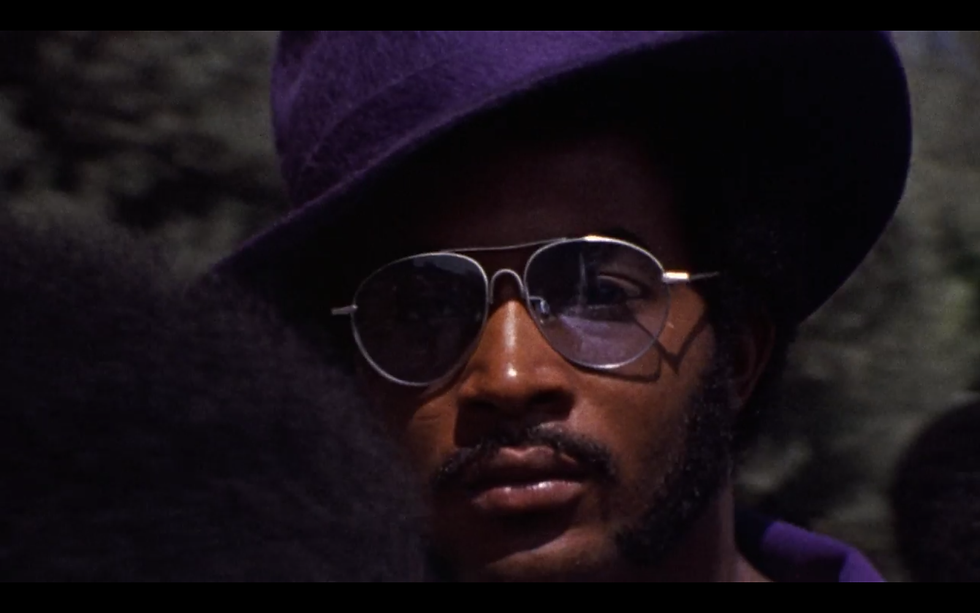
Reverend Jesse Jackson, attended in a multicoloured dashiki as he urged everyone in attendance to repeat, “I am somebody!” Their attire, similar to the Black Panther uniform allowed them to further express their identities and physically illustrated their commitment to their revolutionary ideas.

Visibility was also extremely important to those at Wattstax. When the Watts riots took place in Los Angeles the black citizens of Watts sent a message to the world, demanding that their struggle be noticed. Now at Wattstax those in attendance styled themselves as visionaries.
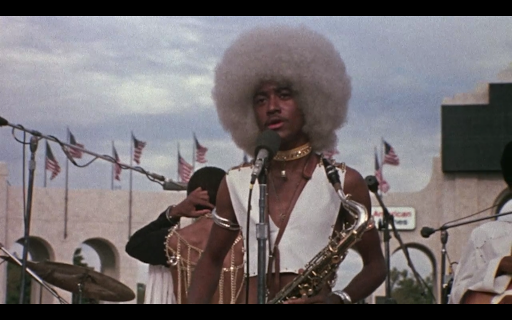
Before their performance the Harvey Henderson, of the Bar-Kays in his flashy white cropped vest, bold jewellery and large grey Afro, says to the crowd: “It has been said many times, many places, that freedom is a road seldom traveled by the multitude. But we’d like to invite each of you to go with us and perhaps you will see a side of life you've never seen before." With their eccentric styles of dress, the performers of Wattstax were proclaiming their existence and inviting others to join them on their pursuit for freedom. The wonderfully striking fashions of many in the crowd perhaps suggests that they were already on the same quest. These people were coming together demanding to be seen and heard. Their appearances communicated the message that they were here, they proudly existed, and that their struggles should be listen to.

Works Cited
Ford, Tanisha C. Liberated Threads: Black Women, Style, and the Global Politics of Soul. University of North Carolina Press, 2017.
Photos taken from Wattstax. Directed by Mel Stuart, Stax Records and Wolper Productions, 4 February 1973.
White, Shane, and Graham J. White. Stylin': African-American Expressive Culture from Its Beginnings to the Zoot Suit. Cornell University Press, 1999.
Thank you for visiting The Wattstax - Group C/Spring 2019 M158C & M150C Introduction to African American Studies website. Before you leave hit play below and "Breakdown!"
Video:
Concertgoers at Wattstax dance to Rufus Thomas's "Breakdown" in 1972. Check out that style, from fashion to dance in a celebration of black culture.
In this video RUFUS THOMAS performs "Breakdown" (#funky #breakdown #funkychicken #poplocking) The music revelers cannot resist his groove and get down to the music.
Rufus Thomas in his clean pink attire said to everybody, "Ain't I'm clean" at Wattstax 1972.

Sources:
Rufus Thomas in pink attire: http://bowdigs.blogspot.com/2016/02/wattstax.html
Video performance of "Breakdown" by Rufus Thomas https://youtu.be/QSxyU-AbF6M

Comments